
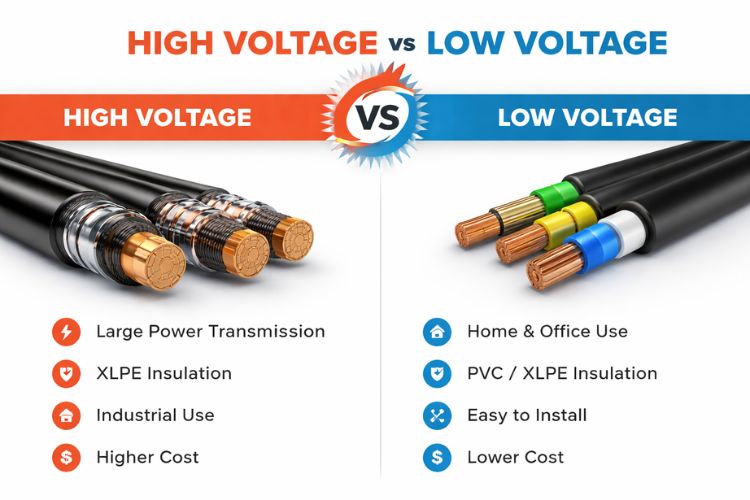

High Voltage Power Cable vs Low Voltage Cable: What’s the Difference?
Choosing the right cable is important for safety, efficiency, and long-term performance. When you compare high voltage power cable vs low voltage cable, the main difference lies in load capacity, distance, and usage.
In simple terms, both cables serve different purposes. Therefore, understanding their differences helps you make better decisions for your project.
What is a High Voltage Power Cable?
A high voltage power cable carries electricity above 1100 volts. It is mainly used in large power systems. For example, it connects power plants to substations and industries.
Moreover, modern cables use XLPE insulation. As a result, they last longer and perform better.
Key Features of High Voltage Cables:
- Long Lifespan: With proper installation and maintenance, cables with XLPE insulation can last 25–30+ years.
- High Load Capacity: Efficiently carries large amounts of electricity over long distances with minimal losses.
- Flexible Installation: Modern designs allow easier installation in underground or complex environments.
- Strong Durability: Resistant to heat, moisture, chemicals, and mechanical stress.
Therefore, industries prefer high voltage cables for reliable performance.
What is a Low Voltage Cable?
In the comparison of high voltage power cable vs low voltage cable, low voltage cables are used for systems operating at 1100 volts or below. They are commonly used in residential, commercial, and small-scale industrial applications.
Common Uses of Low Voltage Cables:
- Low voltage lighting cable – ideal for home and decorative lighting
- Single-core aluminium armoured cable – used in local power distribution
- Unarmoured aluminium power cable – suitable for single-phase and three-phase systems
These cables are cost-effective, easy to install, and perfect for everyday electrical needs.
High Voltage Power Cable vs Low Voltage Cable – Key Differences
| Aspect | High Voltage Cable | Low Voltage Cable |
|---|---|---|
| Voltage Range | Above 1100V | Up to 1100V |
| Application | Power plants, substations, industries | Homes, offices, local use |
| Materials | XLPE insulation, Copper/Aluminium | PVC/XLPE, Copper/Aluminium |
| Cost | Higher due to advanced insulation | More economical |
| Lifespan | 30+ years | Comparatively shorter |
Benefits of High Voltage Power Cables
When comparing high voltage power cable vs low voltage cable, high voltage systems offer several advantages:
- Efficient Transmission: Reduces energy loss over long distances
- Higher Capacity: Can handle large electrical loads
- Durability: Performs well in harsh environments
- Installation Flexibility: Suitable for underground and industrial setups
- Environmental Resistance: Withstands moisture, UV exposure, and temperature variations
Choosing Between High Voltage and Low Voltage Cable
Selecting the right cable depends on your project requirements:
- For heavy industrial use, power plants, and large infrastructure, high voltage power cable is the best choice.
- For homes, offices, and small commercial setups, low voltage cable provides a reliable and cost-effective solution.
In short, when evaluating high voltage power cable vs low voltage cable, consider factors like load demand, distance, safety, and budget.
Conclusion
Both high voltage power cable and low voltage cable serve different purposes in the electrical industry. High voltage cables are designed for large-scale power transmission, while low voltage cables support everyday residential and commercial needs.
At Tradewinds International, we supply high-quality high voltage and low voltage cable solutions, ensuring durability, safety, and long-term performance for every project.
Frequently Asked Questions (FAQs)
Q1. What is the main difference between high voltage and low voltage cables?
High voltage cables operate above 1100V and are used in industrial applications, while low voltage cables work up to 1100V and are used in homes and offices.
Q2. How long do high voltage cables last?
With proper installation and maintenance, they can last more than 25–30 years.
Q3. Can low voltage cables be used in industries?
They can be used in small-scale setups, but large industrial operations require high voltage cables.
Q4. What affects high voltage cable price?
Factors include conductor size, insulation type, voltage rating, and installation conditions.
Q5. Who are reliable high voltage cable suppliers?
Tradewinds International is a trusted supplier offering durable and high-performance cable solutions.