
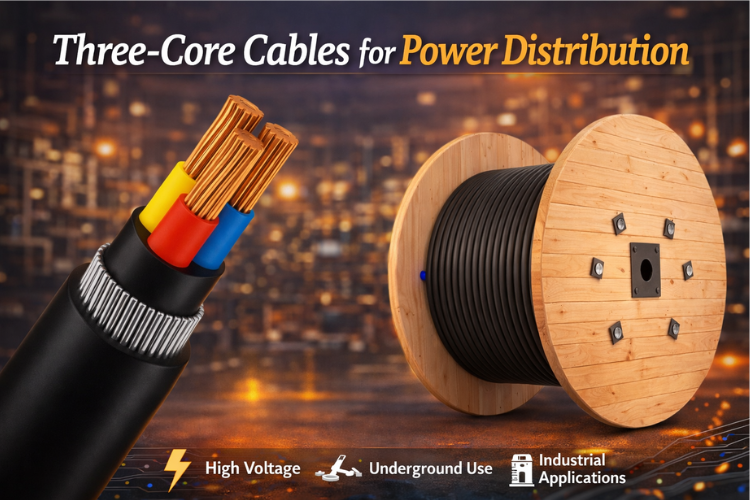

In modern power distribution systems—whether in industrial zones, commercial complexes, or infrastructure projects—the reliability and safety of electrical cables are extremely important. Power cables are responsible for transmitting electricity efficiently while ensuring operational safety.
Among the different types of cables used today, Three Core Cables play a vital role due to their strong design, efficiency, and capability to handle heavy electrical loads with reliable protection.
Whether you are planning underground power distribution, industrial machinery power supply, or medium-voltage installations, Three Core Cables provide a dependable and efficient solution. Let’s explore what these cables are, their structure, advantages, and where they are commonly used.
What Are Three Core Cables?
A Three Core Cable is an electrical cable that contains three separately insulated conductors (cores) enclosed within a single protective outer sheath. Each conductor generally carries one phase of electricity, making the cable ideal for three-phase power distribution systems.
These cables are commonly used in medium-voltage and high-voltage power transmission, typically ranging from 1.1 kV to 33 kV or higher depending on the application.
The conductors are usually made from high-conductivity copper or aluminum, while the insulation material is commonly XLPE (Cross-Linked Polyethylene), known for its excellent thermal performance and electrical insulation properties.
Because of their robust construction, Three Core Cables are widely used in demanding environments such as industrial plants, substations, underground cable networks, and large infrastructure projects.
Structure and Construction of Three Core Cables
A typical Three Core High Tension (HT) Cable is designed with multiple protective layers to ensure durability, safety, and performance.
Key components include:
Conductor
The conductor is usually made of stranded copper or aluminum to provide better flexibility, conductivity, and efficient power transfer.
Insulation Layer
Most high-voltage cables use XLPE insulation, which offers superior resistance to heat, electrical stress, and moisture.
Inner Sheath
This layer provides additional protection and helps maintain the cable’s structural integrity.
Armouring (Optional)
Steel wire or steel tape armouring is added for mechanical strength, especially for underground installations or harsh environments.
Outer Sheath
The outer protective layer is typically made from PVC or polyethylene (PE) to protect the cable from environmental factors such as moisture, chemicals, and physical damage.
Each layer contributes to ensuring long-term reliability and safe power transmission.
Applications of Three Core Cables
Three Core Cables are widely used in various sectors where three-phase power systems are required.
Industrial Power Distribution
Large industrial facilities rely heavily on three-phase electricity to run heavy machinery and equipment. Three Core HT Cables are commonly used to power motors, drives, compressors, and large machines in industries such as steel, cement, textile, and chemical manufacturing.
Underground Power Networks
In urban areas where overhead lines are impractical, three core high-tension cables are widely used for underground power distribution. Their strong insulation and mechanical protection make them ideal for trenching and duct installations.
Substations and Transformer Connections
Three Core Medium Voltage Cables are frequently used to connect transformers, switchgear systems, and distribution panels, ensuring stable and balanced power flow across the network.
Renewable Energy Projects
Renewable energy installations such as solar farms and wind power plants depend on three-phase electrical systems. Three Core Cables help connect inverters, transformers, and distribution panels, enabling efficient energy transmission.
Power Supply for High-Rise Buildings
Large residential and commercial buildings require three-phase power for systems such as elevators, HVAC units, water pumps, and centralized electrical panels. Three Core HT cables help transmit power from the grid to building transformers or main distribution boards.
Three Core Cables vs Single Core Cables
Electrical engineers often compare Three Core Cables and Single Core Cables when designing power distribution systems.
Single Core Cables
- Contain only one conductor
- Used when flexible routing or phase separation is required
- Often used in large power installations with cable trays
Three Core Cables
- Contain three conductors in one cable
- More compact and easier to install
- Reduce installation complexity
- Lower chances of wiring errors or phase imbalance
In many situations, Three Core Cables simplify installation and improve system reliability, especially in medium-voltage distribution systems.
Advantages of Three Core Cables
Three Core Cables offer several important benefits in power distribution networks.
Efficient Power Transmission
They enable balanced three-phase power transfer, reducing transmission losses and improving overall system efficiency.
Compact Design
With three conductors integrated into a single cable, installation becomes easier and space requirements are reduced.
Improved Safety
Multiple insulation layers reduce the risk of short circuits, electrical faults, and accidental contact.
High Mechanical Strength
Armoured versions offer excellent resistance against mechanical stress, underground pressure, and environmental damage.
Reduced Electromagnetic Interference (EMI)
The close placement of conductors helps cancel electromagnetic fields, minimizing interference with nearby electrical systems.
Important Factors to Consider When Selecting Three Core Cables
Choosing the right Three Core Cable requires evaluating several important technical factors.
Voltage Rating
Ensure the cable matches the system voltage, such as 6.6 kV, 11 kV, or 33 kV.
Conductor Material
Copper offers higher conductivity, while aluminum provides a lighter and more economical option.
Insulation Type
XLPE insulation is preferred for high-tension applications due to its excellent electrical and thermal properties.
Installation Environment
Consider whether the cable will be installed underground, inside ducts, or exposed to chemicals or moisture.
Standards and Compliance
The cable should meet recognized standards such as IS (Indian Standards) or IEC (International Electrotechnical Commission) to ensure safety and quality.
Making the right choice improves system performance, reliability, and long-term maintenance efficiency.
Sustainability and Energy Efficiency
With the growing focus on energy-efficient infrastructure, Three Core HT Cables are becoming increasingly important. Their design helps minimize power transmission losses, improve thermal management, and support long-term reliability.
Modern manufacturing technologies are also making cables more eco-friendly and recyclable, supporting the development of sustainable power infrastructure and renewable energy systems.
Conclusion
From industrial plants and substations to urban infrastructure and renewable energy systems, Three Core Cables play a crucial role in modern power distribution networks. Their compact structure, high voltage capacity, durability, and safety features make them a reliable choice for critical electrical applications.
As demand for efficient and reliable power systems continues to grow, Three Core Cables remain an essential component in modern electrical infrastructure. Reliable manufacturers such as TWI Wire & Cable continue to develop high-performance cable solutions to support the future of power distribution.